The past few weeks, I attended the Homegrown Music Fest in Downtown, the Deep Ellum Outdoor Market (of course), and the Brew Riot in Bishop Arts. Security is key to all outdoor events, such that the City of Dallas requires Dallas Police presence to ensure the safety of all in attendance. From an event coordinators perspective, this is an expensive but necessary cost, as it's important to have a smooth running event.
It's even better when the police have a positive comments of the event. Packing up our booth at Homegrown, I overheard a few cops saying how it was a well run event with a good crowd that didn't cause trouble. As I handed our officer his check and thanked him for coming out, he told me that he looks forward to the Market every month. At Brew Riot, surrounded by hundreds of people drinking, I witnessed a few cops joking around with each other knowing that vigilance was not a priority on the day.
It's crucial that people have a good time at these events, but it's even more important that everyone feel safe, and if we make the cops' jobs easier, then we make it easier to pull off these special events in the future. Most importantly, the people who come out to these events, I've observed, appreciate the quality of experience and respect the work it takes it pull these things off.
Friday, May 27, 2011

Tuesday, April 12, 2011
Impact city neighborhoods by creating public space.
Before attending the City of Dallas' Deep Ellum Area Revitalization project presentation last week, I would have signed off on improved streetscaping and bike lane installation without even thinking. Indeed, I am always in favor of walkability and bikeability in neighborhood design, but the point of these meetings is to get everyone's perspective on the project and to be open to contrary opinions. Many why's, who's, and how's were asked, but there were a few objections to the plan that stood out to me.
To paraphrase: Where are the people going to come from when the plan eliminates street parking crucial to the businesses on Elm St.? Who says there will be bicyclists and pedestrians? Furthermore, why would street improvements attract more business to Deep Ellum? The plan, as it stands, will eliminate 24 street parking spots from Good Latimer to Hall. These spaces create easy access to the establishments up and down this corridor of Elm St. Additionally, there is skepticism that widening sidewalks would actually promote pedestrian activity.
This got me thinking about the DART Rail and the strategy for its implementation. DART won an award for building the longest light rail public transportation in the United States but experienced a drop in ridership from 2009 to 2010 despite extending the Green Line just before wintertime. And this when gas has become more expensive! The DART Rail is an example of infrastructure development before destination development.
The lesson to be learned from DART is connecting sites is not as important as connecting destinations. Following a trend and implementing a greener technology does not necessarily make people buy your product. Granted, this rail system exists, but does it take you to places that you want to go to? To apply this to the streetscaping plans, is it reasonable to believe people will want to walk the Deep Ellum sidewalks just because the pavement is wide and a bike can share the road with a car? It is much more reasonable to believe that people will walk to and from a desirable destination for the simple pleasure of doing so.
The question now is how do you develop a destination? To quote the authors of Suburban Nation:
There is currently a lack of these kinds of places throughout Dallas, but Deep Ellum is a perfect candidate to feature such a public space. Deep Ellum feels divided by Hall St. where the west side of the neighborhood features most of the eateries, drinking holes, and metered parking, as opposed to the east side, where most people live and don't pay to park. A public space would connect these places and provide a communal area to enjoy at any hour of the day, much like how the Main Street Garden Park serves Downtown Dallas today. Imagine the sight in Deep Ellum of residents, Downtown visitors, and Baylor folk communing in a comfortable and shady environment.
As it stands, most of the activities in the neighborhood are on the west side of Deep Ellum where parking is at a premium because of the expectation of convenient, direct to the door, parking. A walkable streetplan would open up the rest of the neighborhood to foot traffic and incentivize people to park farther and walk longer. In truth, there's scant reason nowadays for a person to park near Undermain Theater to watch a show at Trees, even though the walk takes less than 10 minutes. To promote this kind of pedestrian activity, make it worth that person's time to stroll through an area worth caring about.
How about holding off on the monstrous task of reformatting Elm St. and develop a public space that will not handicap the businesses that are currently thriving in the renewed interest in Deep Ellum? It is such a crucial time for the businesses trying to gain a foothold in the local economy that hindering access to them is dangerous. Since the City of Dallas has money to spend on Deep Ellum, develop a project that helps the local businesses, encourages residents out of their lofts, and attracts people from neighboring communities.
To paraphrase: Where are the people going to come from when the plan eliminates street parking crucial to the businesses on Elm St.? Who says there will be bicyclists and pedestrians? Furthermore, why would street improvements attract more business to Deep Ellum? The plan, as it stands, will eliminate 24 street parking spots from Good Latimer to Hall. These spaces create easy access to the establishments up and down this corridor of Elm St. Additionally, there is skepticism that widening sidewalks would actually promote pedestrian activity.
This got me thinking about the DART Rail and the strategy for its implementation. DART won an award for building the longest light rail public transportation in the United States but experienced a drop in ridership from 2009 to 2010 despite extending the Green Line just before wintertime. And this when gas has become more expensive! The DART Rail is an example of infrastructure development before destination development.
The lesson to be learned from DART is connecting sites is not as important as connecting destinations. Following a trend and implementing a greener technology does not necessarily make people buy your product. Granted, this rail system exists, but does it take you to places that you want to go to? To apply this to the streetscaping plans, is it reasonable to believe people will want to walk the Deep Ellum sidewalks just because the pavement is wide and a bike can share the road with a car? It is much more reasonable to believe that people will walk to and from a desirable destination for the simple pleasure of doing so.
The question now is how do you develop a destination? To quote the authors of Suburban Nation:
"Just as it is difficult to imagine the concept of family independent of the home, it is near-impossible to imagine community independent of the town square...In the absence of walkable public places - streets, squares, and parks, the public realm - people of diverse ages, races, and beliefs are unlikely to meet and talk."Any visitor to New York City will see how crucial Washington Square Park and Union Square are to their respective communities. Both are comfortable and inviting public spaces that give people access to other people, things to do, and other places around the city
There is currently a lack of these kinds of places throughout Dallas, but Deep Ellum is a perfect candidate to feature such a public space. Deep Ellum feels divided by Hall St. where the west side of the neighborhood features most of the eateries, drinking holes, and metered parking, as opposed to the east side, where most people live and don't pay to park. A public space would connect these places and provide a communal area to enjoy at any hour of the day, much like how the Main Street Garden Park serves Downtown Dallas today. Imagine the sight in Deep Ellum of residents, Downtown visitors, and Baylor folk communing in a comfortable and shady environment.
As it stands, most of the activities in the neighborhood are on the west side of Deep Ellum where parking is at a premium because of the expectation of convenient, direct to the door, parking. A walkable streetplan would open up the rest of the neighborhood to foot traffic and incentivize people to park farther and walk longer. In truth, there's scant reason nowadays for a person to park near Undermain Theater to watch a show at Trees, even though the walk takes less than 10 minutes. To promote this kind of pedestrian activity, make it worth that person's time to stroll through an area worth caring about.
How about holding off on the monstrous task of reformatting Elm St. and develop a public space that will not handicap the businesses that are currently thriving in the renewed interest in Deep Ellum? It is such a crucial time for the businesses trying to gain a foothold in the local economy that hindering access to them is dangerous. Since the City of Dallas has money to spend on Deep Ellum, develop a project that helps the local businesses, encourages residents out of their lofts, and attracts people from neighboring communities.
Tuesday, March 22, 2011
The complications of food in Dallas public markets.
It's easy to compare Big D with the Weird City down south, and the general conclusion is that Dallas isn't as cool as Austin. The Capitol of Texas is lucky to be located in beautiful Hill Country, to house the University of Texas, and to have flexible laws that allow for creative use of space. Food trucks and farmers markets are all the rage nowadays, and whereas one Texan city has been open to their use, another to the north has made them more difficult than they need to be.
We had a nerve wracking visit from Code Compliance last Saturday at the Market. We were prepared, having applied for and received a Temporary Food Service Permit (TFSP) for the one vendor we thought would actually need it. The last time I talked to someone at the Health Department at Goforth Rd. in December, the supervisor told me that 1) a properly licensed food truck would not need a TFSP when used in conjunction with a Special Event Permit, 2) a vendor selling closed food products did not need a TFSP, and 3) a vendor selling produce would need a TFSP. Apparently, it really matters who talks to you at the City of Dallas because the ginger haired code inspector who came by knew nothing of this supervisor who had promised an easy time having food at the Market.
The ginger inspector informed me that the Food Truck indeed needed its own TFSP. Also, the vendors who give out samples of their food also require a TFSP. If they sold jars of their product without letting people sample them, then no TFSP would be necessary.
I understand the need to regulate the food that people are consuming at a public event. Being the one responsible for the Market, the last thing I want to see is someone getting sick off the food being served. What is prohibitive about this process is the cost and confusion of doing it right by the City. The TFSP costs $190 and can cover up to 5 vendors for $5 per vendor. In other words a permit for 5 vendors costs $215, but a permit for 2 vendors costs $200, so a permit for 7 vendors is $415.
The permit does not differentiate between food producers whose ingredients do or do not include potentially harmful food (PHF). If it is consumable, it needs a permit, including coffee or tea. Even pickles and jelly, which are foodstuffs developed over the course of human history as a form of food preservation, are lumped together with perishable meats and cheeses. As a result, DEOM is restricted to booking food vendors at multiples of 5.
As is in Dallas, it's impossible for food trucks and markets (nationwide trends) to operate within the Central Business District. If a food vendor wants to sell anywhere else in Dallas, they need a markets permit ($100 for the first and $50 for each additional market) and a TFSP on top of a food managers license, food manufacturing permit, certified kitchen information, and food handlers license. Luckily, a market director is allowed to file the TFSP to alleviate a little bit of this cost.
What I wish for is a simpler and more cost and time efficient way of getting permitted. I would like an organized governing body for this, so that Special Events, Health Department, Code Compliance, and Farmers Market can figure out what the other guy is telling people. I would like to give input on a proper way of licensing these types of events that protects the City and also allows vendors to make money. Dallas is literally the only City in the US that makes its food vendors pay $200 for the privilege of selling their delicious delectables.
We had a nerve wracking visit from Code Compliance last Saturday at the Market. We were prepared, having applied for and received a Temporary Food Service Permit (TFSP) for the one vendor we thought would actually need it. The last time I talked to someone at the Health Department at Goforth Rd. in December, the supervisor told me that 1) a properly licensed food truck would not need a TFSP when used in conjunction with a Special Event Permit, 2) a vendor selling closed food products did not need a TFSP, and 3) a vendor selling produce would need a TFSP. Apparently, it really matters who talks to you at the City of Dallas because the ginger haired code inspector who came by knew nothing of this supervisor who had promised an easy time having food at the Market.
The ginger inspector informed me that the Food Truck indeed needed its own TFSP. Also, the vendors who give out samples of their food also require a TFSP. If they sold jars of their product without letting people sample them, then no TFSP would be necessary.
I understand the need to regulate the food that people are consuming at a public event. Being the one responsible for the Market, the last thing I want to see is someone getting sick off the food being served. What is prohibitive about this process is the cost and confusion of doing it right by the City. The TFSP costs $190 and can cover up to 5 vendors for $5 per vendor. In other words a permit for 5 vendors costs $215, but a permit for 2 vendors costs $200, so a permit for 7 vendors is $415.
The permit does not differentiate between food producers whose ingredients do or do not include potentially harmful food (PHF). If it is consumable, it needs a permit, including coffee or tea. Even pickles and jelly, which are foodstuffs developed over the course of human history as a form of food preservation, are lumped together with perishable meats and cheeses. As a result, DEOM is restricted to booking food vendors at multiples of 5.
As is in Dallas, it's impossible for food trucks and markets (nationwide trends) to operate within the Central Business District. If a food vendor wants to sell anywhere else in Dallas, they need a markets permit ($100 for the first and $50 for each additional market) and a TFSP on top of a food managers license, food manufacturing permit, certified kitchen information, and food handlers license. Luckily, a market director is allowed to file the TFSP to alleviate a little bit of this cost.
What I wish for is a simpler and more cost and time efficient way of getting permitted. I would like an organized governing body for this, so that Special Events, Health Department, Code Compliance, and Farmers Market can figure out what the other guy is telling people. I would like to give input on a proper way of licensing these types of events that protects the City and also allows vendors to make money. Dallas is literally the only City in the US that makes its food vendors pay $200 for the privilege of selling their delicious delectables.
Tuesday, March 15, 2011
The City of Dallas' attempt at progress
In 2010, the City of Dallas had enacted a moratorium on public markets. They had suspended the licensing of markets in general to figure how they wanted to legislate their implementation. Given the increased interest in community gardens, the City wanted to make sure that the permitting of neighborhood markets was done responsibly and that the new markets did not interfere with the already established Dallas Farmers Market.
Recently in 2011, the City of Dallas has allowed a new permit for "Neighborhood Farmers Markets" (Chapter 29A, Code Compliance), which is undoubtedly a step in the right direction for the promotion of local economy, sustainable living, and a positive image for the City. Knowing that Dallas was working towards this end, we were excited by the prospect of progressive legislation that would accommodate the growing interest in public markets within DFW. Unfortunately, we were disappointed when the provisions of the licensing were published. The Deep Ellum Outdoor Market apparently does not fit the City's definition of a "Neighborhood Farmers Market."
First and foremost, an NFM must be outside the Central Business District and, therefore, does not pose a threat to the Dallas Farmers Market. An NFM does not exceed 50 vendors, and a vendor does not use a space more that 10ft x 10ft. An NFM does not take up more than 25% of the entire area of a parking lot. An NFM is not a flea market, and therefore no more than 50% of the vendors may sell non-food items, additionally no products may be offered for resale. An NFM does not project to attract more than 1000 people including vendors and market staff in a given day. Finally, a market coordinator may not file for a Neighborhood Farmers Market Permit at a separate location.
The Deep Ellum Outdoor Market fails to meet these provisions. The White Rock Local Market, a fine example of a public market, had to turn regular vendors away last weekend because of the stipulations of the City. If the number of vendors you are allowed to have is capped by the product they sell, what happens in extreme weather when produce is scarce? What if the neighborhood where your market is located is a dense one of more than 1000 residents within a square mile?
The way I see it, if you keep telling people what they cannot do, it will make them give up attempting what they want to do. The right thing for a city is to implement a regulatory approach that eschews policing people in favor of establishing rules that follow priorities. Let public intentions and creativity define policy because these specific restrictions hinder growth. This form of legislation is akin to locking the door to paths of progress. In other words, get your greasy fingers out of my business and let me put on a market.
Recently in 2011, the City of Dallas has allowed a new permit for "Neighborhood Farmers Markets" (Chapter 29A, Code Compliance), which is undoubtedly a step in the right direction for the promotion of local economy, sustainable living, and a positive image for the City. Knowing that Dallas was working towards this end, we were excited by the prospect of progressive legislation that would accommodate the growing interest in public markets within DFW. Unfortunately, we were disappointed when the provisions of the licensing were published. The Deep Ellum Outdoor Market apparently does not fit the City's definition of a "Neighborhood Farmers Market."
First and foremost, an NFM must be outside the Central Business District and, therefore, does not pose a threat to the Dallas Farmers Market. An NFM does not exceed 50 vendors, and a vendor does not use a space more that 10ft x 10ft. An NFM does not take up more than 25% of the entire area of a parking lot. An NFM is not a flea market, and therefore no more than 50% of the vendors may sell non-food items, additionally no products may be offered for resale. An NFM does not project to attract more than 1000 people including vendors and market staff in a given day. Finally, a market coordinator may not file for a Neighborhood Farmers Market Permit at a separate location.
The Deep Ellum Outdoor Market fails to meet these provisions. The White Rock Local Market, a fine example of a public market, had to turn regular vendors away last weekend because of the stipulations of the City. If the number of vendors you are allowed to have is capped by the product they sell, what happens in extreme weather when produce is scarce? What if the neighborhood where your market is located is a dense one of more than 1000 residents within a square mile?
The way I see it, if you keep telling people what they cannot do, it will make them give up attempting what they want to do. The right thing for a city is to implement a regulatory approach that eschews policing people in favor of establishing rules that follow priorities. Let public intentions and creativity define policy because these specific restrictions hinder growth. This form of legislation is akin to locking the door to paths of progress. In other words, get your greasy fingers out of my business and let me put on a market.
Wednesday, March 9, 2011
The Upcycling Revolution
Recycling is the processing of used material into something more useful. The products of recycling fall into two categories: 1) Downcycling - creating products of lower value, and 2) Upcycling - creating products of higher value. An example of downcycling would be processing used office paper into toilet paper, while examples of upcycling can be found in multiple booth spaces at the Deep Ellum Outdoor Market.
Upcycling is the repurposing of an excess of unused resources into something usable. The common expression is "one man's waste is another man's treasure," but upcyclers see it a different way. To the upcycler, waste or unused material doesn't immediately convert to treasure, rather, the product goes through a transformation according to the vision of the artist.
Recycle, repurpose, recreate is the mantra at the heart of this movement. Melanie Woods of threeRdesigns refashions old records, cassette tape inserts, and chip bags into wallets, notebooks, and purses. Caleb Massey of Red Ranger Rayguns transforms otherwise useless gun-shaped tools and toys into Atomic Disintegrators and other futuristic imaginings.
Recycling is all about reducing the rate of consumption of raw materials, while upcycling does this and increases the value of the product at the same time. Nowadays, reusing quality, older paraphernalia outweighs the expense of utilizing raw materials.
The Deep Ellum Outdoor Market itself is a reinvention of public space. What was otherwise 5000 square feet of car shade is now a place of commerce and a reason to inhabit a space of little use. What we intend to do is produce a quality, positive experience to attract a lot of people, in other words, to upcycle the parking lot.
Deep Ellum has the advantage of being a place that has been attractive to people ever since Bonnie and Clyde terrorized Texas banks in the early 20th century. Over time, the buildings have been repurposed to fit the needs of the contemporary generation. So, what does this generation need, and how can we use the resources available to us to make it happen?
Upcycling is the repurposing of an excess of unused resources into something usable. The common expression is "one man's waste is another man's treasure," but upcyclers see it a different way. To the upcycler, waste or unused material doesn't immediately convert to treasure, rather, the product goes through a transformation according to the vision of the artist.
 |
| NiteOwl Z-3 by Red Ranger Rayguns |
Recycling is all about reducing the rate of consumption of raw materials, while upcycling does this and increases the value of the product at the same time. Nowadays, reusing quality, older paraphernalia outweighs the expense of utilizing raw materials.
The Deep Ellum Outdoor Market itself is a reinvention of public space. What was otherwise 5000 square feet of car shade is now a place of commerce and a reason to inhabit a space of little use. What we intend to do is produce a quality, positive experience to attract a lot of people, in other words, to upcycle the parking lot.
Deep Ellum has the advantage of being a place that has been attractive to people ever since Bonnie and Clyde terrorized Texas banks in the early 20th century. Over time, the buildings have been repurposed to fit the needs of the contemporary generation. So, what does this generation need, and how can we use the resources available to us to make it happen?
Driving Ettiquette: The Lane Change
***Originally posted January 6, 2011***
Despite being a proponent of public transportation and alternative means of getting around, I personally am tied to my car. Living in Plano but working in Dallas, a lot of my time on a daily basis is spent in the car. To make up for this 1 1/2 hours of loneliness in my automobile, I listen to talk radio and try to communicate with fellow drivers by hand signal and flashing lights.
Perhaps the most frustrating maneuver to perform while traversing the motorways is the lane change. What makes it so difficult is anticipating the expectations of the drivers in the desired lane. In other words, is that dude (not to be gender specific) gonna let me in, or is he gonna make me work for it?
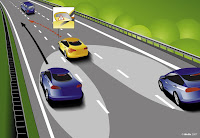 My intention is rather clear by the turn signal: I need to move over. But what will be the reaction of the driver? It would really help me out if the driver slows down a little bit to clear a space that would ease my lane change. More often than not in this damn city, however, the driver speeds up and blocks a clear path to the next lane.
If this is the status quo in drivers' etiquette, what does that say about our expectations from each other when we're not in our cars? Is this why it's so difficult to pursue progress in Dallas? In the pursuit of change in lanes or civic mentality, why does blocking a clear path become an instant, initial obstacle?
Despite being a proponent of public transportation and alternative means of getting around, I personally am tied to my car. Living in Plano but working in Dallas, a lot of my time on a daily basis is spent in the car. To make up for this 1 1/2 hours of loneliness in my automobile, I listen to talk radio and try to communicate with fellow drivers by hand signal and flashing lights.
Perhaps the most frustrating maneuver to perform while traversing the motorways is the lane change. What makes it so difficult is anticipating the expectations of the drivers in the desired lane. In other words, is that dude (not to be gender specific) gonna let me in, or is he gonna make me work for it?
 My intention is rather clear by the turn signal: I need to move over. But what will be the reaction of the driver? It would really help me out if the driver slows down a little bit to clear a space that would ease my lane change. More often than not in this damn city, however, the driver speeds up and blocks a clear path to the next lane.
If this is the status quo in drivers' etiquette, what does that say about our expectations from each other when we're not in our cars? Is this why it's so difficult to pursue progress in Dallas? In the pursuit of change in lanes or civic mentality, why does blocking a clear path become an instant, initial obstacle?
The Philosophy of the Suburb part 1: The Cul-de-Sac
***Originally posted November 30, 2010***
The Deep Ellum Outdoor Market represents a common occurrence that happens in neighborhoods primed to be successful urban areas. It's important, then, to look at areas not primed to be successful public places to help define what we need urban spaces to be.Dallas is a place with many people in the suburbs and few public spaces in urban areas. Over the course of a few entries, I'll be breaking down the suburbs into component parts to figure out what is the ultimate goal of the suburb. If an ideal urban neighborhood seeks to bring people together, what does a suburban neighborhood seek to do?
The first component of suburbia I will cover is the cul-de-sac. It's a French word that means bottom of the bag, but it's also a staple of subdivision design ubiquitous in any suburban neighborhood in any town in the nation.
A cul-de-sac is a street that ends with a bunch of houses circling the truncated area. They were implemented in American subdivision development after World War II with the intention of limiting through-traffic in residential areas.
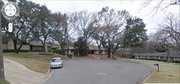 There's no reason to drive down a cul-de-sac if you don't live in that pocket of houses, so cars are filtered out into busier capillary streets. Traffic, in turn, concentrated in streets that led out of the subdivision, thereby reducing noise, traffic, and air pollution for those lucky to buy up the real estate in less traveled areas.
The cul-de-sac also allows developers to pack more families into irregular plots of land. Instead of allowing people access to larger thoroughfares, developers could fit in a few more houses within the subdivision. If the developers' layout met a particular quota, there were Federal Housing Administration incentives for people to buy homes in these particular subdivisions.
Let's take a look at the cul-de-sac in it's extreme form. Here is a satellite photo of a subdivision in West Plano.

SW of Parker and Preston. 1/2 mile east to west, 1/4 mile north to south.
In this photograph, it's easy to spot no fewer than 9 cul-de-sacs in the neighborhood. The cul-de-sac design accomplishes its mission by restricting flow into and out of the area to only four roads: Sleepy Hollow Dr., Silver Creek Dr., Coventry Ln, and Bellaire Dr. Only two of them reach out to one of the main thoroughfares, Parker Road! In this case, inner neighborhood traffic is limited to these few roads while the other streets are free from traffic.
The drivers traveling on Parker and Preston, in turn, are completely oblivious to the residents of the neighborhood as those cars race by in a 45mph zone.
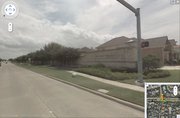 Additionally, there are long stretches of sidewalk bordered by a brick barrier protecting the subdivision in a way that no wall ever protected the Alamo. Pedestrians within the subdivision, like cars, can only leave the neighborhood through one of the 4 roads listed above. A church-goer living in the subdivision would have to drive to the church at Parker and Preston lest they sully their Sunday best clothes climbing the wall to escape the neighborhood.
The developers of this subdivision seem to have left out a human perspective in the design of the place, as the streets certainly cater to the conveniences of the automobile and not the pedestrian. In reference to Jane Jacob's four components of a successful neighborhood, this subdivision follows none of those tenets:
1) There are no mixed use buildings. The closest retail store is farther away than the church and most certainly a drivable distance.
2) There is a lack of interconnected streets. That there are only 2 roads that access the closest major street makes walking in this neighborhood a chore, since there is literally nowhere to walk to.
3) Because there is nowhere to walk to, there are no people on the street. The closest gathering place, the church, is empty save for a few services a week.
4) There is no mix of old and new buildings. The subdivision was created less than a decade ago, so all buildings are of similar age.
When the components of successful public space are completely ignored, we have the modern subdivision, centered around the suburban cul-de-sac, which can be appropriately designated by this street sign:

Subscribe to:
Posts (Atom)